Connection
Grid Connection Is No Longer Just an Approval Process
For a long time, grid connection was treated as a technical approval pathway. Complete the studies. Negotiate performance standards. Submit the models. Close out comments. Get registered. Energise the project. That approach is now too narrow.
Across the National Electricity Market, the challenge is no longer just whether a project can secure approval on paper. The harder question is whether it can operate reliably in a more dynamic, inverter-dominated power system.
That distinction matters.
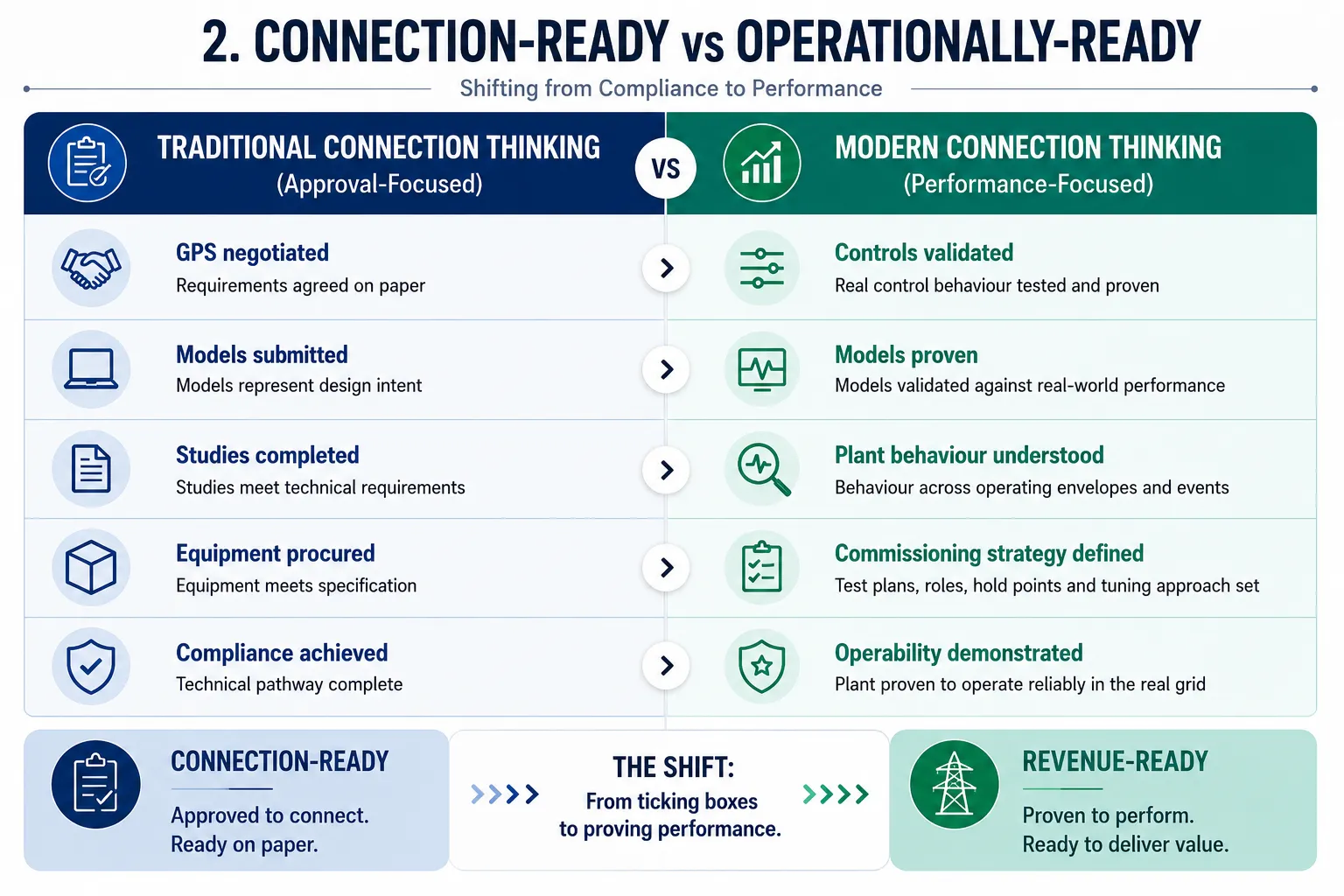
A project can be "connection-ready" from a documentation point of view and still not be "operationally ready" once it faces real network conditions, commissioning tests, control interactions, model validation and evolving system-security requirements.
That is where many projects are now losing time, money and confidence.
The old connection mindset is breaking down
The traditional project mindset was fairly linear:
- finish the design
- complete the studies
- negotiate Generator Performance Standards
- procure major equipment
- arrive on site
- tune controls during commissioning
- reach full output
That sequence made more sense when the grid had stronger synchronous support, fewer inverter-based assets and more predictable operating conditions. It is becoming much weaker as a project strategy.
Today, many renewable, battery and hybrid projects are connecting into areas with lower system strength, changing fault levels, tighter operating envelopes, increased curtailment risk and more nearby inverter-based generation.
The result is simple: grid connection is no longer just a compliance task. It is a system integration exercise.
The pipeline is large, but delivery is the real test
AEMO's latest Connections Scorecard shows the scale of the challenge.
As at March 2026, there were around 189 GW of enquiries across 486 projects in the NEM connection pipeline. That is a huge signal of market interest. But the same scorecard also shows how much that pipeline narrows as projects move through application, proponent implementation, registration and commissioning.
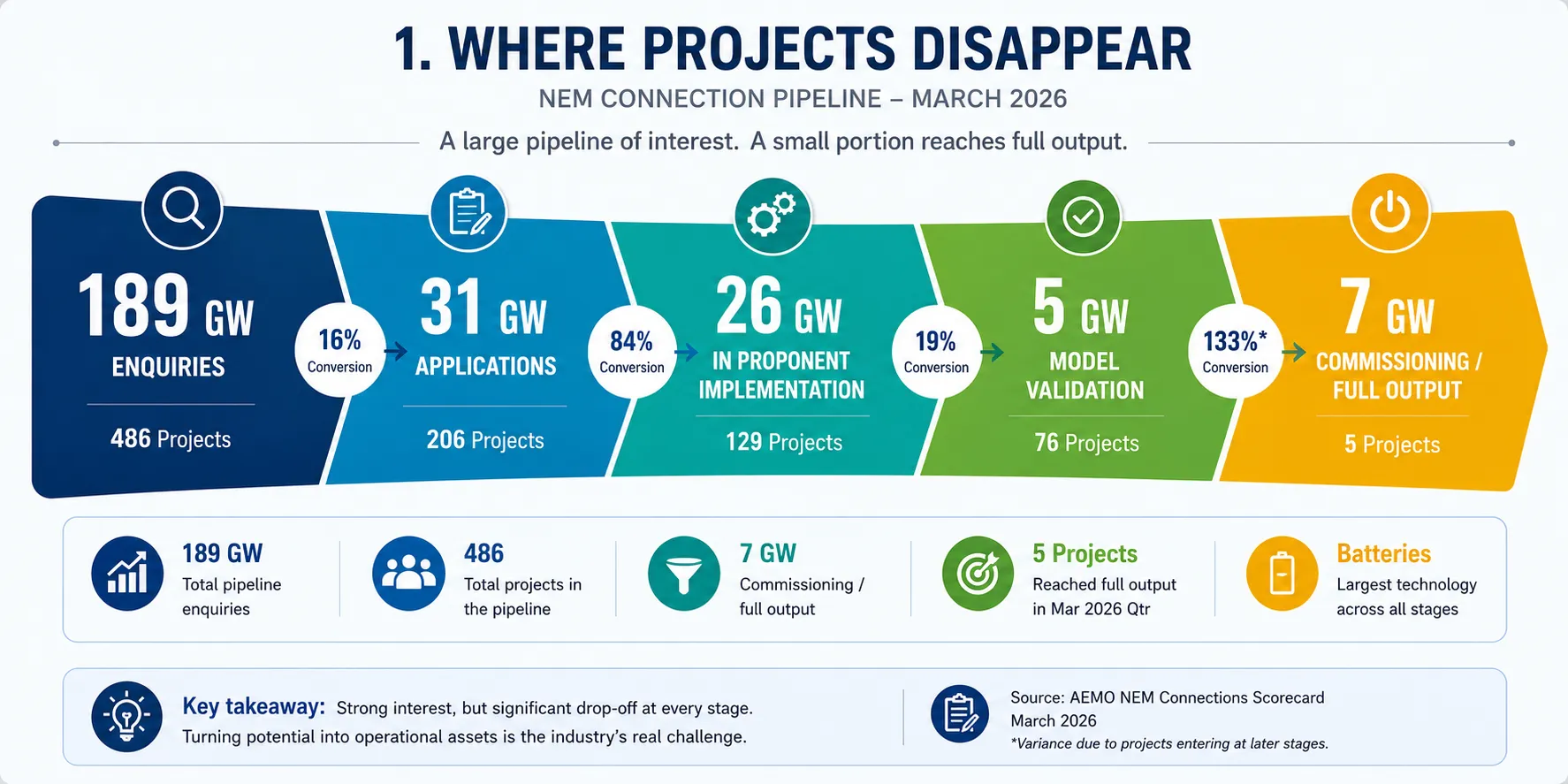
In the March 2026 quarter, only five projects reached full output. Batteries were the dominant technology across every stage of the process.
This is not a criticism of AEMO, developers, OEMs or network service providers. It is a sign that the connection pathway has become technically, commercially and operationally harder.
The industry has plenty of project interest. What it needs is more projects that can move from enquiry to operation without late-stage surprises.
Why projects get stuck
The reasons are rarely simple.
Some delays are commercial: procurement, financing, land access, planning approvals, supply chain pressure and contractor availability.
Some are network-related: outage availability, system strength, transmission constraints, protection requirements and changing connection assumptions.
But many delays are technical and integration-related. Common issues include:
- dynamic model gaps or late model changes
- control tuning issues during commissioning
- poor alignment between OEM behaviour and study assumptions
- weak-grid control interactions
- protection coordination problems
- unexpected oscillations
- delays in model validation
- incomplete commissioning planning
- unclear responsibilities between developer, OEM, EPC, NSP and market bodies
These issues are costly because they usually appear late. A model issue found during early assessment is manageable. The same issue found during commissioning can delay revenue, increase costs and damage trust between stakeholders.
This is why developers should stop treating commissioning as a final-stage activity. Commissioning readiness needs to be built into the project from the start.
Grid-forming technology helps, but it is not a silver bullet
There is growing interest in grid-forming batteries and advanced inverter controls. That interest is justified.
Grid-forming technology will play an important role in supporting future system strength, frequency response, voltage control and system stability. But it is dangerous to assume that all grid-forming capability behaves the same way.
Actual performance depends on:
- OEM implementation
- control philosophy
- state of charge and available headroom
- fault current capability
- network impedance
- nearby plant behaviour
- hybrid plant configuration
- protection settings
- plant controller interactions
- the agreed operating envelope
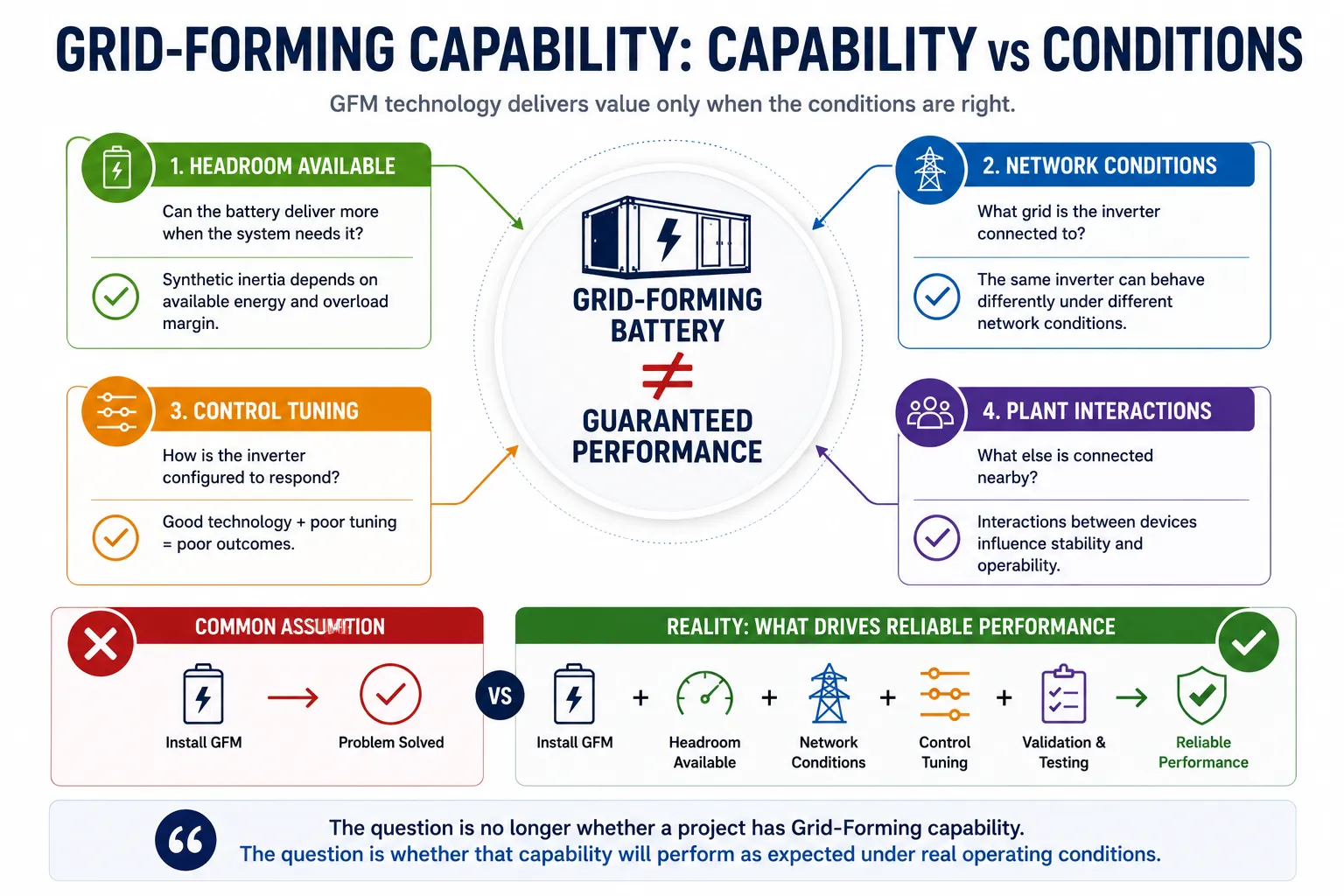
This matters commercially. If a project assumes that grid-forming capability will solve operability issues without understanding the specific control behaviour, it may simply shift the problem into commissioning.
Grid-forming is not a checkbox. It is a technology class with different implementations, limits and tuning requirements.
The better question is not "does the plant have grid-forming capability?" The better question is:
Under what network conditions, operating points and dispatch levels will this capability actually perform as expected?
That question should be answered early, not during commissioning.
Large inverter-based loads are changing the connection conversation
Generation projects are not the only issue anymore. Large data centres, electrolysers, EV charging hubs and other power-electronic loads are becoming more important in grid behaviour.
Historically, loads were often treated as relatively passive. That assumption is becoming weaker. Many large modern loads use software-controlled power electronics. Their behaviour during faults, voltage disturbances, ramping events and recovery conditions can affect system security.
They can create challenges, but also opportunities. For example, large flexible loads may help with minimum system load challenges. Some facilities may also provide fast frequency response or other support services. But if they disconnect or rapidly reduce demand during disturbances, they can also create large contingency events.
This means the future connection conversation will not only be about generators, batteries and transmission. It will also be about how large flexible demand behaves, how it rides through disturbances and how it is coordinated with the broader power system.
What strong projects do differently
The best projects do not wait until commissioning to discover whether the plant works. They do several things earlier.
First, they challenge assumptions before they become commitments. That includes assumptions about system strength, control mode, operating envelope, fault ride-through, reactive capability, harmonic behaviour and curtailment exposure.
Second, they involve OEMs early. The OEM's real control behaviour matters more than a generic technology description. If the OEM model, plant controller and protection design are not aligned early, the project is already carrying hidden risk.
Third, they treat model governance seriously. Dynamic models are not just submission artefacts. They are the basis for performance assessment, registration, commissioning and future operational confidence.
Fourth, they plan commissioning before procurement is locked in. Test plans, hold points, responsibilities, site access, outage windows and tuning requirements should be understood before the project gets boxed into a delivery pathway.
Fifth, they treat operability as a commercial issue, not just an engineering issue. Every week of delayed commissioning affects revenue. Every unexpected constraint affects the business case. Every unresolved technical assumption can become a commercial dispute.
The shift developers cannot ignore
The NEM is moving towards higher renewable penetration, lower synchronous generation and more complex interactions between generation, storage, networks and flexible demand.
That shift does not mean projects cannot connect. They can. But the projects that perform best will be the ones that approach grid connection as a system integration challenge from day one.
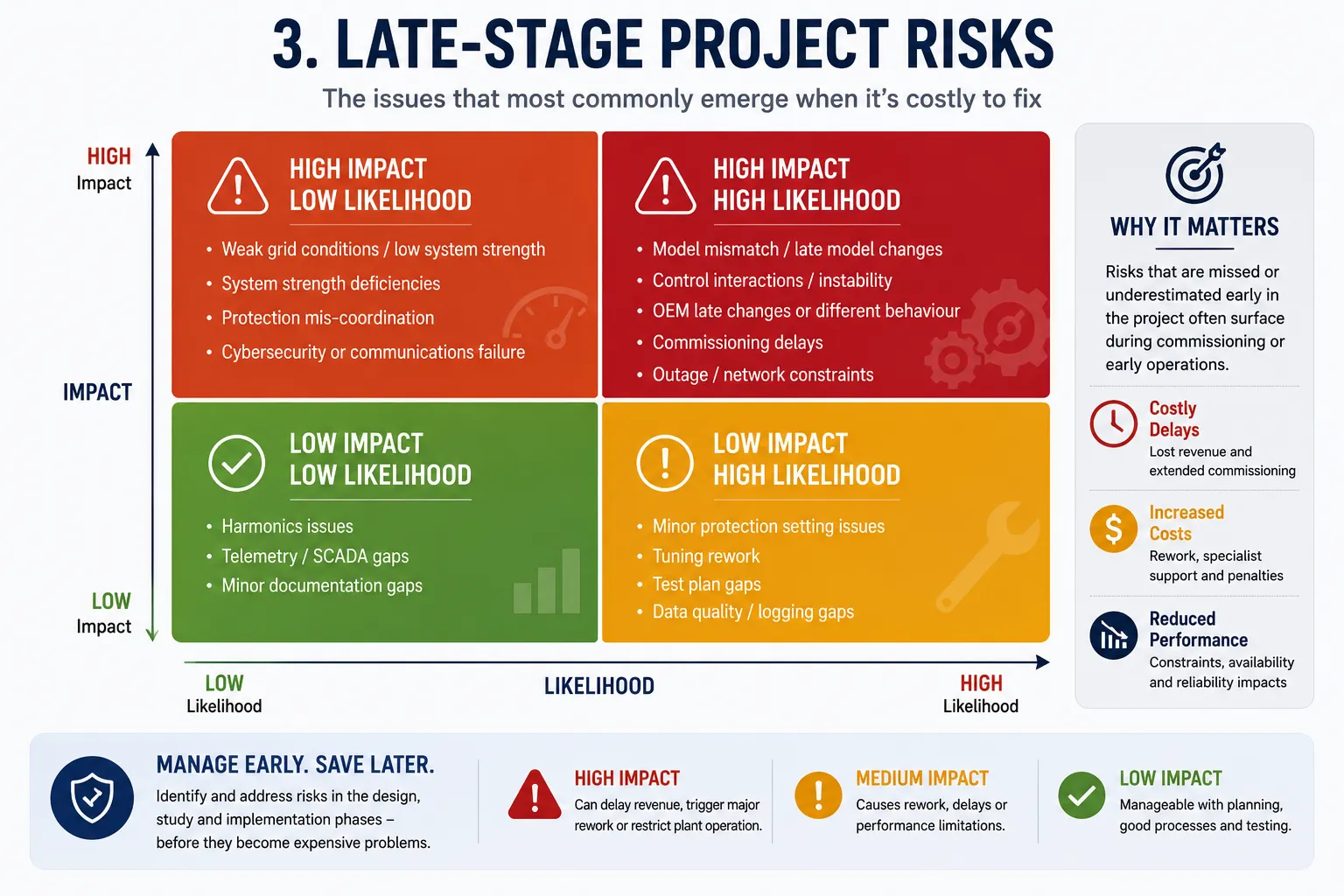
That means earlier technical due diligence. Better model governance. Stronger OEM engagement. Clearer commissioning planning. More realistic risk allocation. And a sharper understanding of how the plant will behave under real grid conditions.
At Grid Axis, this is where we focus. We help developers, OEMs, EPCs and project owners move beyond paperwork compliance and build practical confidence that their project can connect, commission and operate reliably.
The industry does not just need more projects in the pipeline. It needs more projects that can reach full output, operate predictably and support the power system they are joining.
That is the new grid access challenge.
Sources
- Australian Energy Market Operator, NEM Connections Scorecard – March 2026.
- Australian Energy Market Operator, 2025 Transition Plan for System Security.
- Australian Energy Market Operator, Grid-forming Technology Access Standards Approach Paper, 2025.
- International System Operator Network / AEMO, Large Power Electronic Loads – Challenges and Insights, November 2025.
- Clean Energy Council, Clean Energy Australia Report 2025.
- Australian Energy Market Operator, 2024 Integrated System Plan.